
Guide · types of chocolate
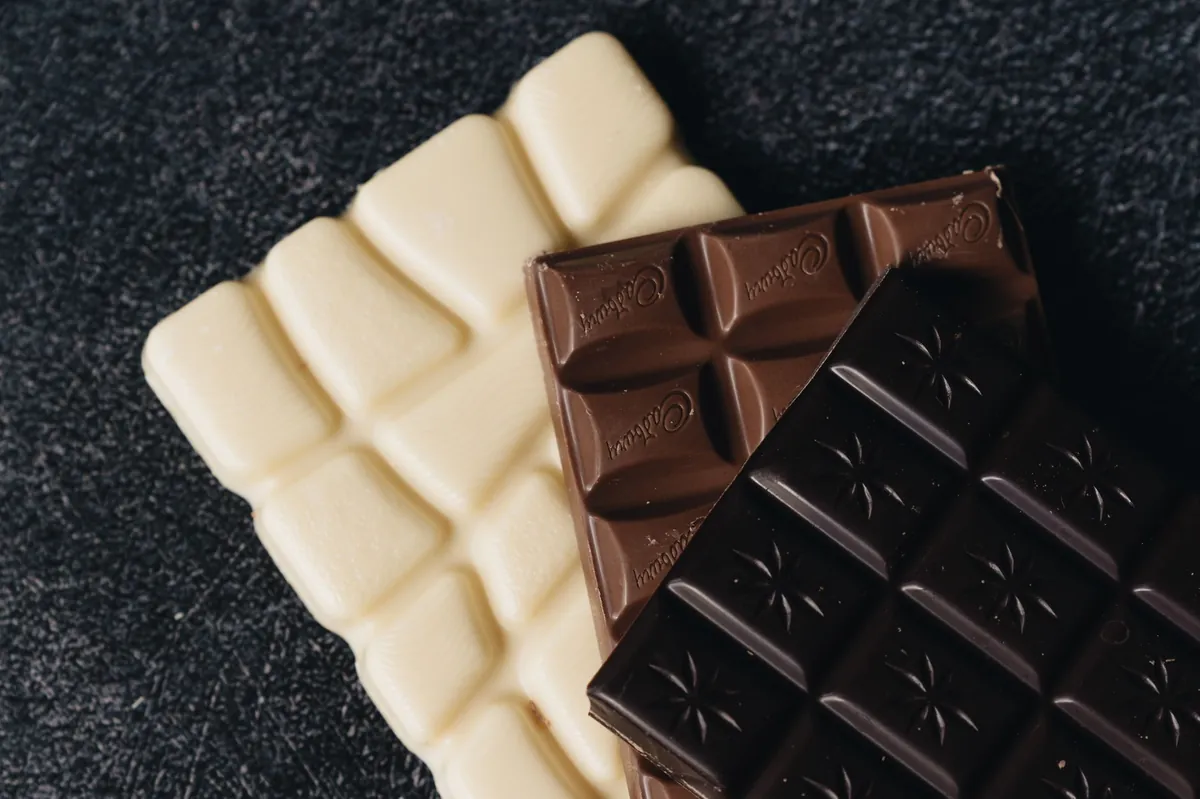
Chocolates don’t just differ in flavour. The real difference lies in how much cocoa mass they contain and what kind of fat goes into them. That is how the types of chocolate are divided: dark, milk and white — and since 2017 there is also a newcomer, ruby chocolate. We’ll go through all four, tell you what percentage of cocoa a good bar should have, and show you how to spot quality right on the label.
At a glance
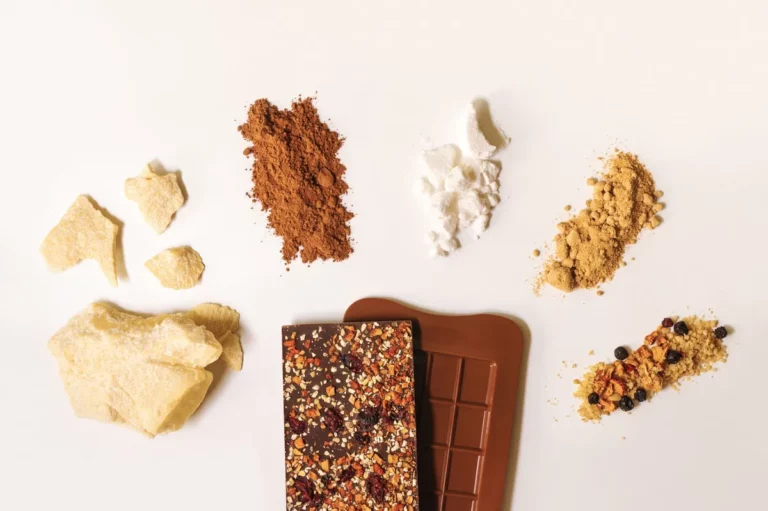
Real chocolate rests on three ingredients: cocoa mass, cocoa butter and sugar. Cocoa mass is made by grinding roasted cocoa beans and gives chocolate its colour and bitterness. Cocoa butter is the fat from the same bean, and it gives chocolate its gloss and that typical way of melting on the tongue.
And this is where European law steps in with clear rules: if a manufacturer replaces cocoa butter with cheaper vegetable fat beyond the permitted limit, the product may no longer be called chocolate. That is why the first thing we look for on a label is cocoa butter. We’ll come back to it further down.
Another figure on labels that can be confusing: cocoa solids are not the same as cocoa mass. They are the sum of everything that comes from the cocoa bean — cocoa mass and cocoa butter together. So when a wrapper says ‘70% cocoa’, it means that 70% of the bar is made up of these two components and the remaining 30% is mostly sugar.
How many cocoa solids each type must contain is set by a standard — and that is what sets the different chocolates apart.
The most sought-after type and also the simplest: cocoa mass, cocoa butter, sugar. No milk. The European standard requires at least 35% total cocoa solids, but typical bars range between 55 and 85%.
The higher the share of cocoa, the less sugar and the more pronounced the bitterness. That is exactly why dark chocolate works so well in baking: in a dough or batter, the sugar in the recipe balances it out and the flavour stays full. For coatings and ganache it is the obvious choice.
The flavour also varies depending on where the beans come from. African cocoas tend to be earthy and distinctly bitter, South American ones more fruity and acidic. It’s the same principle as with coffee or wine — the origin of the raw material shows in the result. That’s why on our plantations in Mexico’s Yucatán we grow the Criollo variety, known precisely for its delicate, aromatic flavour.
A practical guide to which chocolate to buy: around 55% for coatings and desserts for children, 60–70% for doughs and ganache, 75% and above for snacking, when you want a pronounced bitterness.
Add milk powder to the same base — and everything changes. The standard requires at least 25% cocoa solids and at least 14% milk solids.
Milk softens the bitterness, adds a creamy note and sweetens the chocolate. But it melts at a lower temperature and burns more easily as you work with it, so it needs gentler heat than dark chocolate when melting.
Incidentally, milk chocolate is the second youngest of the four: it was first made in 1875 by the Swiss Daniel Peter, who managed what nobody had before — combining chocolate with milk so that the mixture didn’t turn damp. He was helped by milk powder from his neighbour, a certain Henri Nestlé.
A question that comes up all the time. The answer is yes, but let us explain.
White chocolate contains no cocoa mass — which is why it isn’t brown. It does, however, contain cocoa butter, the fat from the cocoa bean, and the standard requires at least 20% of this butter and at least 14% milk solids. So there is cocoa in it, just in a form that doesn’t add colour.
It is the sweetest of all chocolates and also the most sensitive to heat. Once it burns and turns lumpy, there is no way to rescue it — which is why it is melted very carefully and never directly on the hob.
Nestlé brought it to market in 1936, originally as a way to use up surplus cocoa butter left over from making cocoa powder. In patisserie today it is mainly used where contrast should shine: with fruit, with tangy fillings, or as white decoration on a dark dessert.
Ruby was launched in 2017 by the Swiss company Barry Callebaut, which presented it as the fourth type of chocolate. It is pink in colour, with a tangy, fruity flavour.
Let’s be straight about it: from the point of view of European law, it is not a new type at all. Ruby is chocolate like any other — what’s new is the processing. Its colour and acidity come from a special process using selected cocoa beans, not from added colouring or fruit flavouring. So the pink is genuine; the ‘fourth type’ is marketing.
How is it done? The manufacturer selects beans with a particular profile and processes them in a way that preserves the natural colour and acidic compounds that are lost during ordinary fermentation and roasting. Its cocoa solids content is around 47%, so in sweetness ruby is closer to milk chocolate than to dark.
Ruby is becoming a very sought-after chocolate, yet clear, accurate information about it is hard to find — which is why we’ve included it here.
(comparison block with bars — % cocoa)
In the shop you’ll find bars ‘for snacking’ next to packs labelled cooking chocolate. The difference isn’t in quality but in what the product is intended for.
Cooking chocolate tends to have a higher share of cocoa butter, so it melts more easily and is more fluid once melted — which makes it easy to work with for coatings and doughs. It is also usually cheaper, because you are not paying for a thin bar and luxury packaging.
But watch out for one thing: some products sold as a ‘coating’ are not chocolate. Their cocoa butter has been replaced with vegetable fat, they set on their own without tempering, and they go by names such as ‘confectioner’s coating’. They hold beautifully on a cake, but in flavour they can’t compete with chocolate. Just check the ingredients.
For baking, ordinary bar chocolate is perfectly fine too — just chop it finely so that it melts evenly.
Here is probably the most widespread misconception: a higher percentage on its own does not mean better chocolate.
The percentage only tells you how many cocoa solids are in the bar — not how good the beans were, how they were roasted or how long the chocolate was conched. An eighty-per-cent bar made from poor beans will simply be bitter; a seventy-per-cent bar made from good ones will be fragrant and full of flavour.
In practice, the best-rated bars sit somewhere between 60 and 75%. Above 85%, bitterness and astringency overpower the aroma that developed in the bean during fermentation — and that aroma is the most precious thing about good chocolate.
To give you an idea: in a bar with 70% cocoa, the remaining 30% is practically all sugar. In a 50% bar, half is sugar. So the difference between 70 and 85% isn’t about the ‘amount of chocolate’, but mainly about how much sugar balances out the bitterness.
So when you’re choosing, look at the origin of the beans and the ingredients rather than the big number on the front of the wrapper.
By the label and by your senses.
On the label:
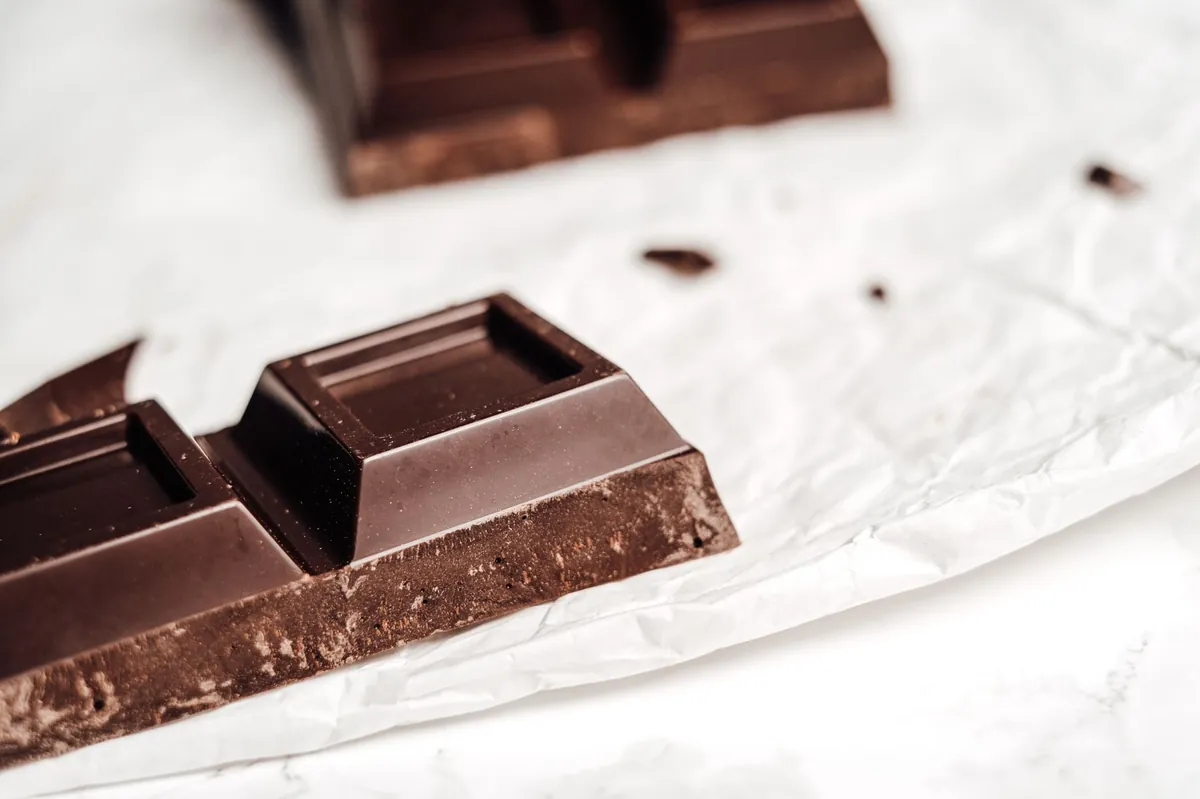
By your senses: a quality bar is smooth and glossy, snaps cleanly when broken and melts on the tongue without feeling greasy. A dull surface and a soft break are usually signs of poor tempering or storage.
Dark chocolate contains magnesium, iron and flavanols — antioxidants from the cocoa bean. At the same time it contains a lot of fat and sugar, so we can’t quite call it a ‘health food’.
Let’s stick to what is actually backed up: the European Food Safety Authority (EFSA) has approved just one health claim for cocoa — that cocoa flavanols help maintain the elasticity of blood vessels, which contributes to normal blood flow, with an intake of 200 mg of flavanols per day. Nothing else has been approved so far.
So how much can we eat a day? A sensible portion is 20–30 grams, which is two to three squares. More than that mainly means more sugar and energy.
Also be careful with theobromine, a substance that occurs naturally in cocoa and acts as a stimulant. It doesn’t bother people, but it is toxic to dogs — the higher the share of cocoa, the more dangerous. So keep chocolate out of dogs’ reach.
Chocolate likes dry, dark conditions and a steady temperature of around 15–18 °C. It doesn’t like the fridge: in damp and cold it develops a white bloom, and it also easily picks up smells from the food around it.
That white bloom isn’t mould, and the chocolate hasn’t gone off because of it — cocoa butter or sugar rises to the surface because of temperature fluctuations. The flavour practically doesn’t change, only the appearance.
How long does it keep? Dark chocolate in unopened packaging easily lasts one to two years — with so little water in it, nothing happens to it. Milk and white chocolate have a shorter shelf life because of the milk solids, roughly a year. Wrap an opened bar and eat it within a few weeks, before it picks up smells from its surroundings.
It contains magnesium, iron and cocoa flavanols. The only health claim EFSA has approved for cocoa concerns flavanols and the elasticity of blood vessels with an intake of 200 mg a day. The other effects attributed to chocolate have not been backed up so far.
A sensible portion is 20–30 grams a day, which is two to three squares.
Yes. It contains no cocoa mass, which is why it isn’t brown, but it does contain cocoa butter — the standard requires at least 20%.
A pink chocolate with a tangy, fruity flavour, launched in 2017 by Barry Callebaut. The colour comes from special processing of selected beans, not from colouring. Legally, it is not a new type of chocolate.
No. The percentage only tells you the share of cocoa solids. Quality depends on the origin of the beans, the roasting and the conching — the best-rated bars are usually between 60 and 75%.
You can compare all the types of chocolate on a tour of our chocolate factory in Průhonice near Prague, where it is made straight from the beans grown on our own plantation.
Factory tour