
Guide · celebrations
A chocolate fountain with a smooth curtain of chocolate cascading down it is often the highlight of any celebration — as long as the chocolate doesn’t turn into a mass full of lumps. The whole secret rests on three things: the right chocolate for a chocolate fountain, the right temperature and enough of everything.
At a glance
We’ll go through it all, so that the best chocolate flows from your fountain all evening long.
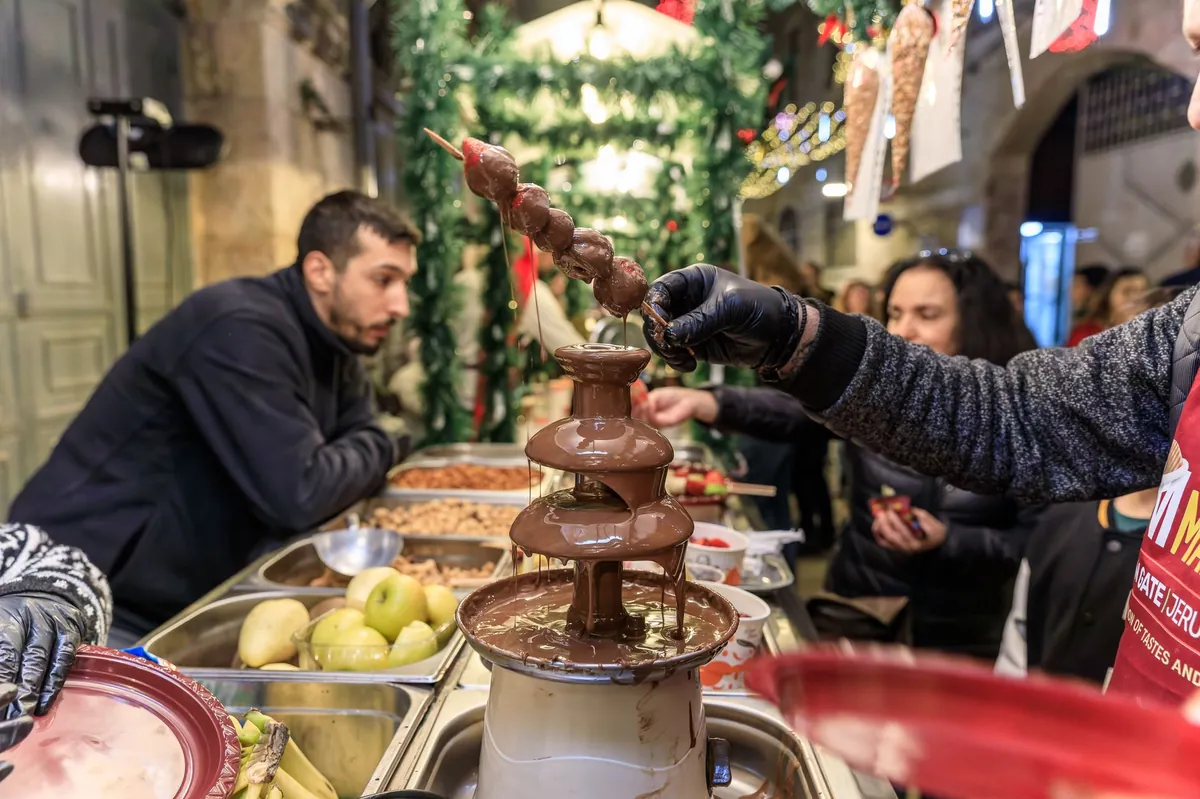
In the middle of the fountain is a spiral — the auger — which moves the chocolate from the heated basin up to the top of the fountain. From there the chocolate cascades over the individual tiers, creating the effect of a continuous flowing curtain. The basin at the bottom keeps it warm the whole time.
For the chocolate curtain to stay smooth, the chocolate has to be runny enough. And here’s the key point: ordinary bar chocolate is too thick for a fountain. The auger struggles to pick it up, so it only drips from the top and the chocolate curtain breaks.
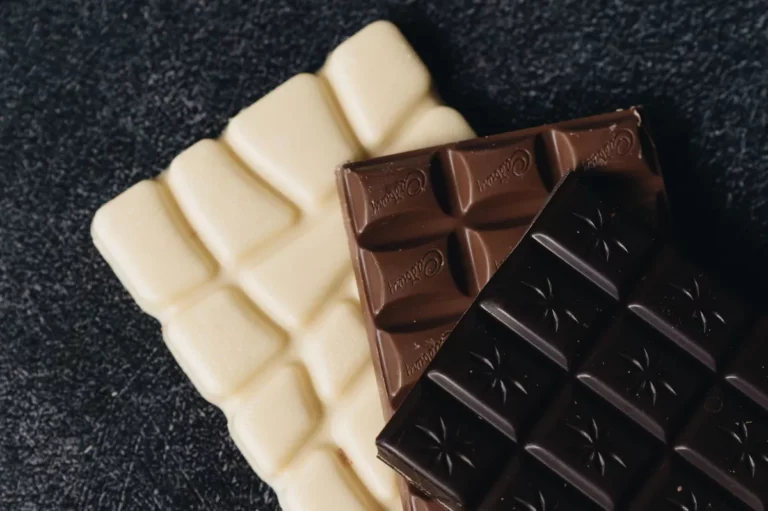
The best chocolate for a fountain has a higher share of cocoa butter — the fat that makes chocolate runny once melted. Chocolate callets made for pastry chefs work best: they melt evenly and flow on their own.
Which type you choose depends mainly on who will be gathering round the fountain:
Its flavour shines with strawberries, oranges and pineapple. It tolerates the highest temperature, so it’s the easiest to work with in a fountain.
A safe bet when there will be children at the fountain too. Sweeter and creamier, it goes well with bananas, sponge fingers and marshmallows.
It’s the sweetest and the most sensitive to overheating: keep it towards the lower limit, around 40 °C. It contrasts beautifully with raspberries and blueberries.
Dark chocolate sweetened with fibre from chicory root. It flows in a fountain just as well as dark chocolate.
A popular trick: mix dark and milk in a 1:1 ratio. The result isn’t as sweet as milk chocolate on its own, yet children still love it.
What not to put in a fountain: confectioner’s coating. It does flow well, because it contains vegetable fat instead of cocoa butter, but in flavour it can’t compare with chocolate — and under the European standard it may not even be called chocolate.
A fountain needs a certain minimum amount, otherwise the auger draws in air and the curtain breaks. The manufacturer always states this minimum in the instructions — start there. As a guide:
Allow roughly 100 g of chocolate per guest. Guests keep coming back to the fountain — and running out of chocolate halfway through the evening is worse than having some left over. What’s more, leftovers can be used again (see below).
Set the fountain up level. Ideally on a table that is completely stable. If it stands at an angle, the chocolate flows down one side only and the chocolate curtain breaks.
Preheat the basin for 5–10 minutes, so that the chocolate doesn’t start to set as soon as you pour it in.
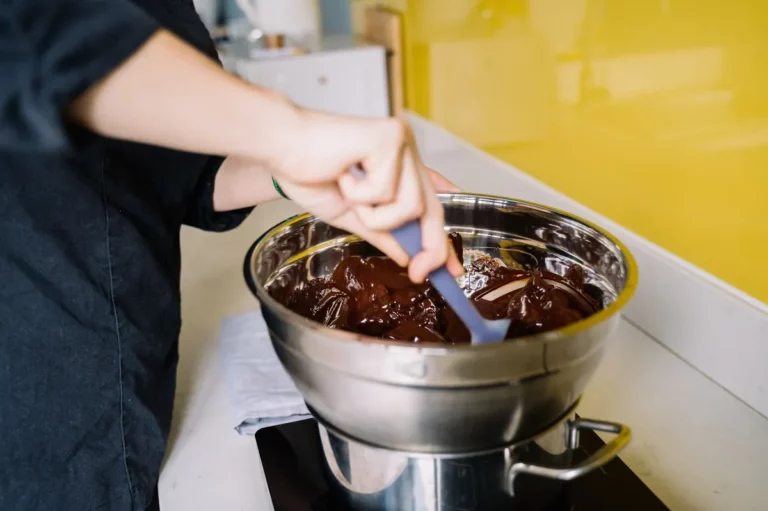
Melt the chocolate separately — in a bain-marie or in the microwave, to 40–45 °C. A fountain is built to hold the temperature, not to melt the chocolate.
Pour it into the basin and switch on the auger. Let the chocolate circulate for the first few minutes and check whether a chocolate curtain is forming.
If there’s no chocolate curtain, thin the chocolate — a little at a time, see the next section.
Stir it now and then during the evening and only ever top it up with pre-warmed chocolate. Cold chocolate would thicken what’s in the basin.
When chocolate flows sluggishly, it needs more fat — never more liquid.
Never add water, milk, cream or butter. They all contain water and will make the chocolate seize into lumps. You’ll then have to clean the fountain and start again.
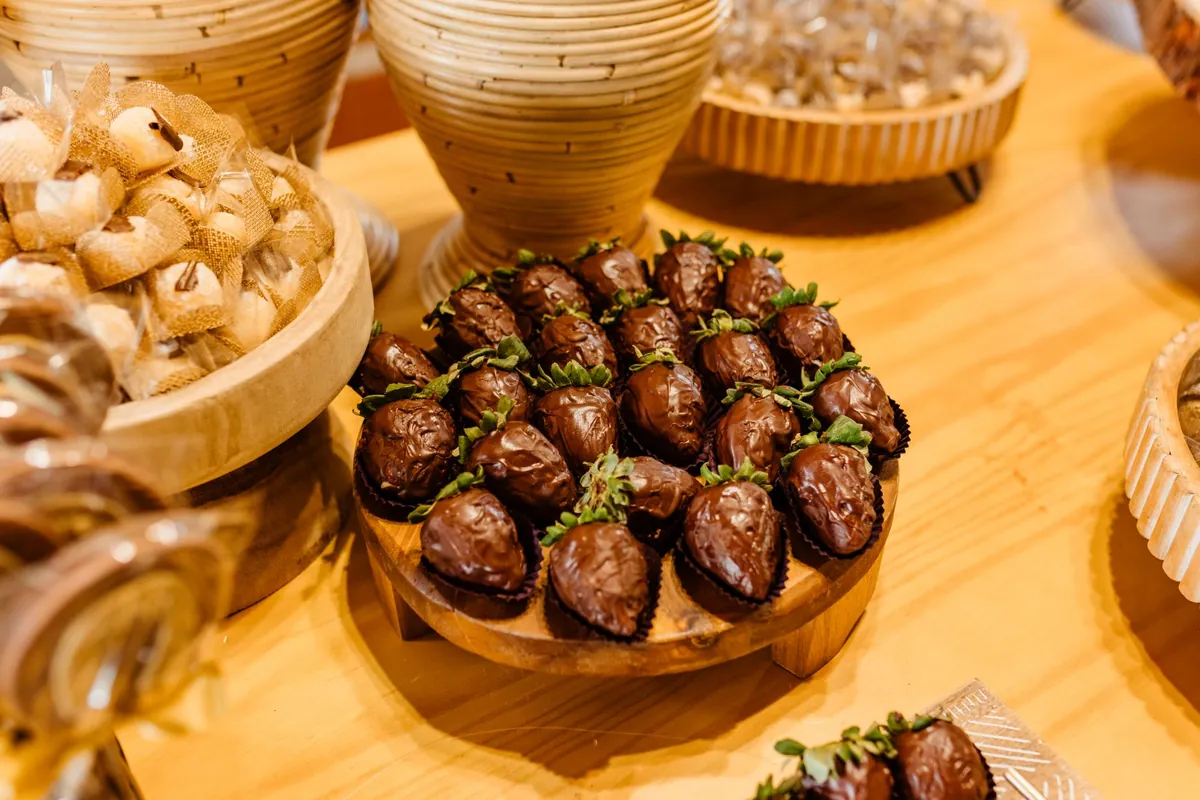
Pieces that are firm, dry and bite-sized work best:
Dry the fruit thoroughly and let it come to room temperature. A drop of water will make the chocolate seize, and cold fruit straight from the fridge will thicken it in the fountain.
What to avoid: anything that crumbles — croissants, cake, crumbly biscuits. Crumbs fall into the basin, clog the auger and the fountain stops flowing.
The curtain breaks or has holes in it. The fountain isn’t level, there’s too little chocolate in the basin, or the chocolate is too thick. Check all three, one by one.
The chocolate is thickening. The room is cold, or the fountain is standing in a draught, next to the air conditioning or by an open window. Move it somewhere sheltered and thin the chocolate if needed.
The fountain bubbles or spits. There’s air in the auger. Switch the fountain off for a moment, stir the chocolate in the basin and switch it back on.
The chocolate is lumpy. Water has got into it — from wet fruit, steam or the utensils. Chocolate like that can no longer be rescued in the fountain.
At a bigger event, the location matters most. Set the fountain up out of direct sunlight and draughts, on a stable table with a tablecloth that can take a few stains. Put out skewers, small plates and napkins next to it — and agree on who will keep an eye on it and top it up during the evening.
For a smaller group, a fountain is unnecessarily big. For four to eight people, a chocolate fondue in a single pot is more practical: you can make it in a few minutes and there’s nothing to hire or clean.
Clean it while the chocolate is still warm — once it has set, it’s much harder to remove.
Switch the fountain off, take off the tiers and the auger, and pour the leftover chocolate from the basin into a container.
Wipe the tiers and the auger with paper towels, then wash them in warm soapy water.
Wipe the basin out and clean it with a damp cloth. Never put the motor base under water.
Leftover chocolate that no crumbs have fallen into can be used again — for baking, for hot chocolate or for your next fondue.
A tip from experience
Before you pour anything into the fountain, put a spirit level on the base. A fountain that stands even slightly askew is the most common reason the chocolate curtain breaks — and it’s not the chocolate’s fault.
Melt it separately in a bain-marie or in the microwave to 40–45 °C, pour it into the preheated basin and switch on the fountain. If the chocolate curtain isn’t continuous, add cocoa butter or neutral oil a little at a time.
A small home fountain needs 1–1.5 kg, a large fountain for events 4–6 kg. Always stick to the minimum stated by the manufacturer and allow roughly 100 g per guest.
Cocoa butter, neutral vegetable oil or coconut oil. Never water, milk, cream or butter — the chocolate would seize.
40–45 °C. White and milk chocolate towards the lower limit, because they overheat sooner than dark.
You can, but it will need thinning considerably — it’s too thick for a fountain. Chocolate callets with a higher share of cocoa butter are easier.
For fondue, chocolate isn’t thinned with oil but melted with cream — roughly 200 g of chocolate to 100 ml of cream. You’ll find the full method in our chocolate fondue recipe.
Dark, milk, white and no added sugar, ready to go straight into your fountain. And if you’re in Prague, we’ll happily deliver a chocolate fondue to your door.
Fountain chocolate